 Skip to content

Startseite
>
<!–Blog–>
The First Winter After Installing a Heat Pump: 7 Essential Settings to Monitor
.custom-breadcrumb {
font-family: ‘Inter’, sans-serif;
font-size: 13px;
line-height: 150%;
letter-spacing: 0px;
display: flex;
align-items: center;
gap: 8px;
}
.custom-breadcrumb a {
font-weight: 400; /* Regular weight */
color: rgba(255, 255, 255, 0.65);
text-decoration: none;
transition: color 0.2s ease;
}
.custom-breadcrumb a:hover {
color: #FFFFFF;
}
.custom-breadcrumb .separator {
color: rgba(255, 255, 255, 0.4);
font-weight: 401;
}
.custom-breadcrumb .current {
font-weight: 500; /* Medium weight */
color: #FFFFFF;
}
.elementor-element-de8fc86 {
position: relative !important;
background-image: url(‘https://fixdone.de/wp-content/uploads/2026/10/01-featured-heat-pump-winter-scaled.avif’) !important;
background-size: cover !important;
background-position: center center !important;
min-height: 480px !important;
}
.elementor-element-de8fc86::before {
content: ” !important;
position: absolute !important;
top: 0 !important;
left: 0 !important;
width: 100% !important;
height: 100% !important;
background: linear-gradient(90deg, rgba(0, 0, 0, 0.85) 0%, rgba(0, 0, 0, 0.85) 55%, rgba(0, 0, 0, 0) 100%) !important;
z-index: 1 !important;
pointer-events: none !important;
}
.elementor-element-de8fc86 > * {
position: relative !important;
z-index: 2 !important;
}
The First Winter After Installing a Heat Pump: 7 Essential Settings to Monitor
Your first winter with a heat pump is an opportunity to understand how your new heating system performs in real conditions. As temperatures fall in Düsseldorf and across Germany, you may notice that radiators feel less hot than before, the heating system runs for longer, or electricity consumption increases during cold spells. These changes do not necessarily indicate a problem.
Heat pumps work differently from gas boilers. Rather than producing very hot water for short periods, they generally operate more efficiently by delivering heat at lower temperatures over longer periods. Their performance also depends on outdoor temperatures, your home’s insulation, the heating system’s design and how well the controls are configured.
The first winter is therefore a tuning period, not a final verdict on efficiency. Monitoring a few important settings and performance indicators can help you recognise normal behaviour, make sensible adjustments and identify problems before they affect comfort or energy costs.

Jawad Malloul
CEO & Geschäftsführer, Energie Metering GmbH
28.10.2026
Published
28.10.2026
Updated
6 Min.
Read time
1. Monitor Your Indoor Temperature
The first priority is simple: can your heat pump keep your home comfortably warm without frequent manual adjustments?
Choose a comfortable target temperature for your main living areas and observe whether the system maintains it throughout the day. Many households start around 20–21°C in living rooms, although the right setting depends on personal comfort, insulation and household needs.
Avoid repeatedly raising and lowering the thermostat to make the system respond faster. Heat pumps often work best with steady heating, particularly in homes with underfloor heating or high thermal mass. Large temperature changes can make the system work harder to restore comfort.
What to Look For
- Comfortable rooms: If your home maintains your preferred temperature, the system may be working as intended even when radiators feel only warm.
- Rooms that heat slowly: Give the system time to respond, especially after a significant temperature setback or a cold night.
- One consistently cold room: Check whether the radiator or underfloor heating circuit is unobstructed and whether the room’s heating controls are set correctly.
- Several cold rooms: If the system runs continuously but cannot maintain the target temperature, ask your installer to investigate the heating curve, water flow, heat output and system configuration.
Do not immediately increase the flow temperature simply because a room feels cool. First check the heating schedule, room controls and heat distribution. If the problem continues, heating system troubleshooting can help you narrow down possible causes before making further adjustments.
Der Haupthahn sitzt meist im Keller, direkt vor oder hinter dem Wasserzähler.
2. Track Electricity Consumption
Electricity use is one of the most useful indicators to monitor during your first winter. However, a heat pump’s consumption naturally changes with the weather, so one high reading does not automatically mean something is wrong.
When outdoor temperatures fall, the heat pump usually needs more electricity to deliver the required heat. Defrost cycles and supplementary electric heating can also increase consumption under certain conditions.
Establish a Baseline
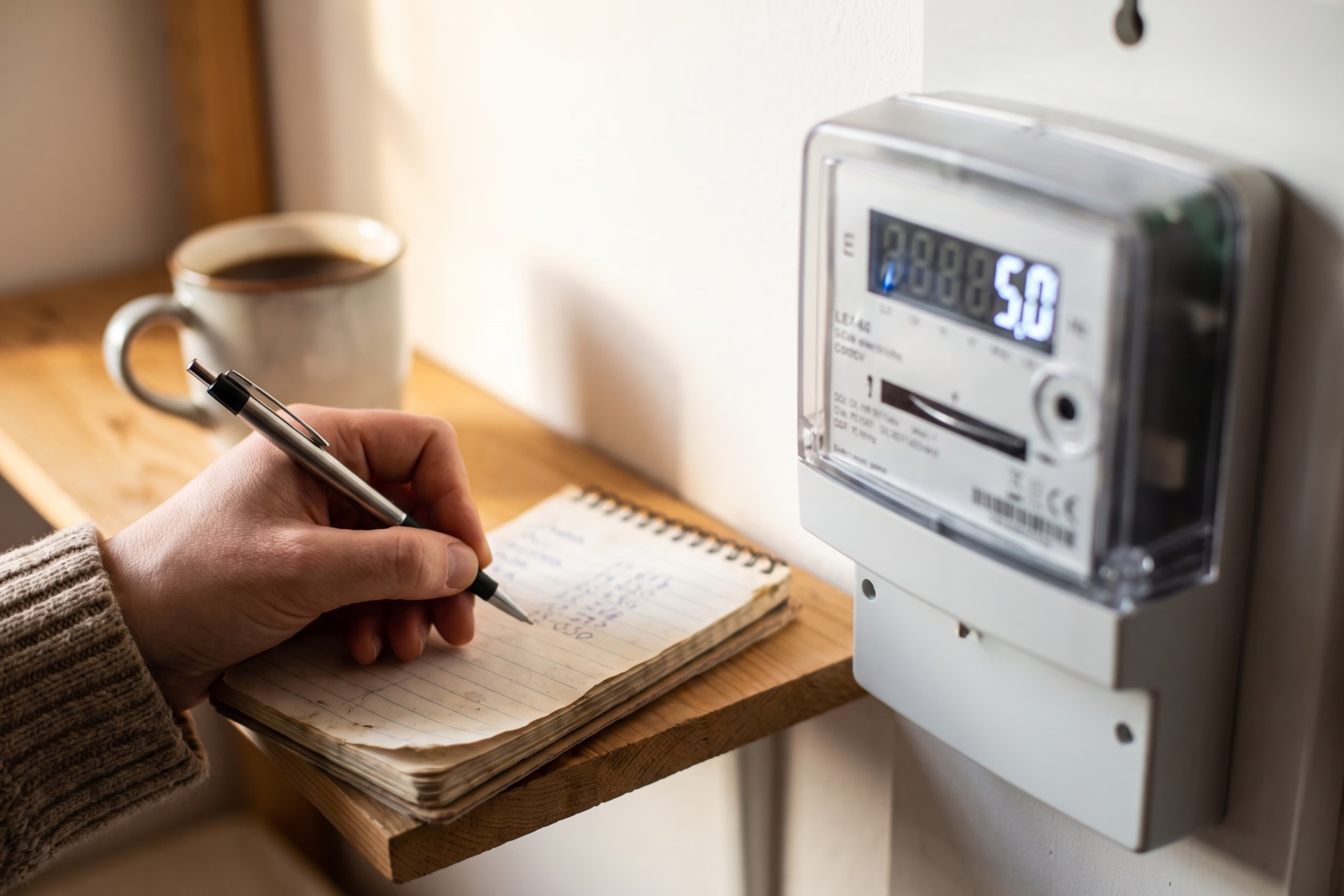
At the start of the heating season, record your electricity meter reading or heat pump energy data. If possible, distinguish the electricity used by the heat pump from the rest of your household consumption.
Note the date, outdoor temperature, indoor comfort level and any significant changes to your heating settings. Check the readings weekly rather than reacting to every daily fluctuation.
For a useful comparison, compare similar periods with similar weather and heating demand. A cold week cannot be compared fairly with a mild week without considering the difference in conditions.
When Higher Consumption Deserves Attention
Investigate further if electricity use rises sharply without a corresponding change in outdoor temperatures or household heating demand. Other warning signs include rooms remaining cold despite prolonged operation, frequent use of electric backup heating, or repeated error messages.
Also check whether your system heats domestic hot water on a schedule that matches your household’s needs. Unnecessarily high hot-water temperatures or frequent reheating can increase electricity consumption.
Keeping track of these readings can also help you understand your heat pump’s running costs and electricity consumption over the heating season.
3. Check the Flow Temperature and Heating Curve
The flow temperature is the temperature of the water leaving the heat pump and travelling through your radiators or underfloor heating circuits. It is one of the most important settings affecting efficiency.
A lower flow temperature generally allows a heat pump to operate more efficiently. However, it must still be high enough to keep your home comfortable during colder weather.
Understand Weather Compensation
Many heat pumps use a weather-compensated heating curve. This automatically adjusts the flow temperature according to the outdoor temperature. When the weather becomes colder, the system increases the water temperature to deliver more heat.
The goal is to find a curve that keeps the house comfortable without making the water unnecessarily hot.
- Rooms are consistently too warm: The heating curve may be higher than necessary.
- Rooms are consistently too cold: The curve may be too low, although other causes should also be checked.
- Comfort is good in mild weather but poor during frost: The curve or the system’s available heating capacity may need professional review.
Make small adjustments only when you understand the controller and its recommended procedure. Allow sufficient time to assess each change, often at least a day or two in reasonably stable weather. Underfloor heating may take longer to respond than radiators.
Avoid changing the heating curve, room thermostat, schedule and flow temperature simultaneously. If several settings change together, it becomes difficult to identify which adjustment helped.
These factors matter when estimating heat pump installation costs in Germany, as the home’s heating requirements and any necessary upgrades can influence the overall investment.
4. Understand Normal Defrost Cycles
In cold, damp weather, frost can form on the outdoor unit’s heat exchanger. The heat pump periodically removes this frost through a process called defrosting.
During defrost, the unit may temporarily change its operating sound, release visible steam or water, and briefly pause normal heat delivery. These effects can be normal, particularly around freezing temperatures when the air contains significant moisture.
What Normal Defrosting Looks Like
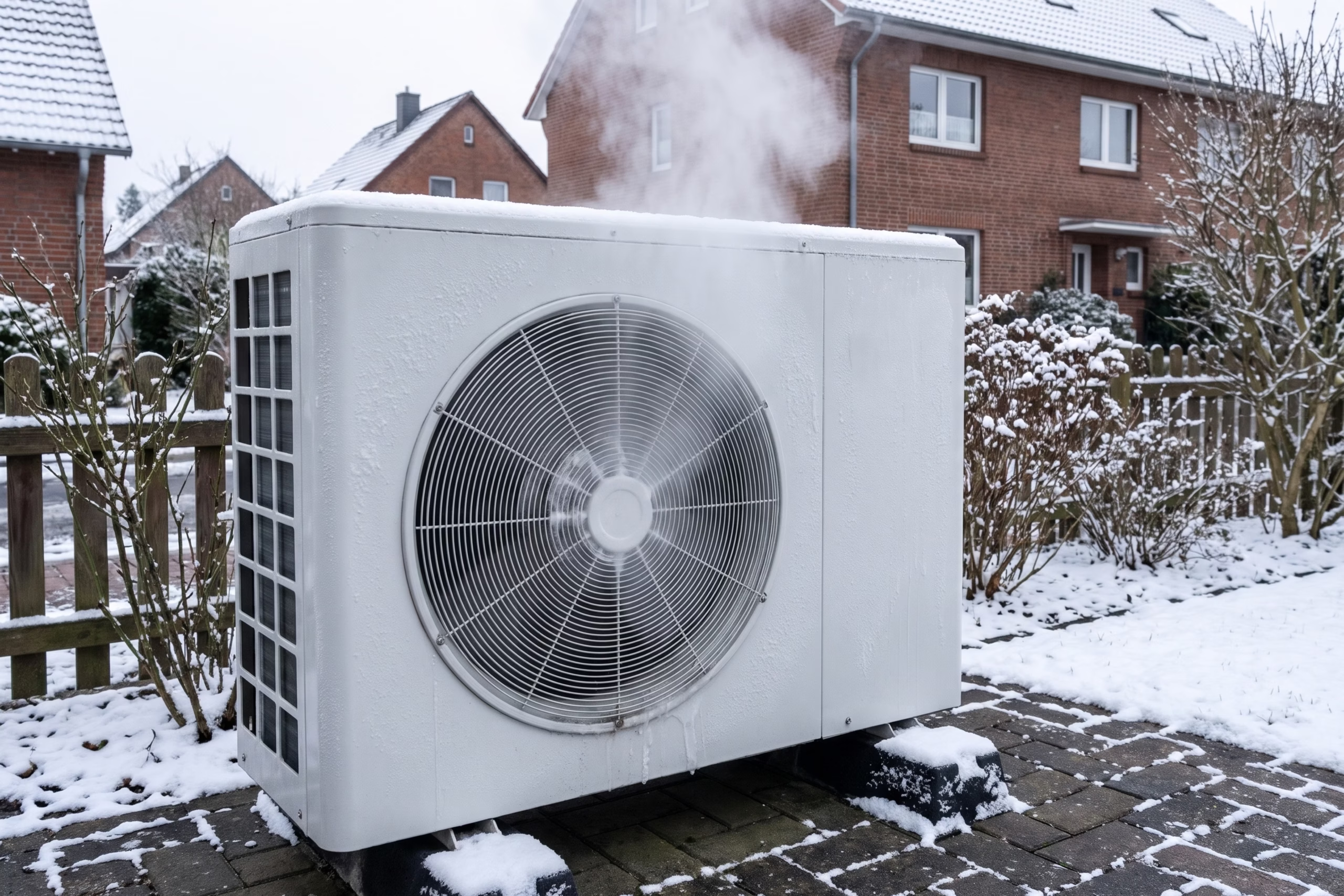
You may notice:
- A temporary change in the outdoor unit’s sound.
- Steam or vapour rising from the unit.
- Water draining beneath the unit.
- A short interruption in heating while the system clears frost.
After the cycle, normal operation should resume. The outdoor unit should have enough space for air to circulate, and defrost water must be able to drain without creating a hazardous ice build-up around walkways.
When to Investigate
Contact your installer if thick ice persists on the heat exchanger, defrosting appears unable to clear the frost, the unit repeatedly reports faults, or the home fails to recover its temperature after normal operation resumes.
Do not chip ice off the heat exchanger or use boiling water to remove it. These actions can damage the unit. Keep leaves, snow and other obstructions away from the manufacturer’s required air intake and discharge areas, following the installation manual.
The manufacturer’s official manual is the most relevant reference for normal defrost behaviour, drainage requirements and model-specific fault indicators.
5. Monitor Hot Water and Backup Heating
Your heat pump may provide both space heating and domestic hot water. These functions have different temperature requirements, so a temporary change in heating behaviour can sometimes be related to hot-water production rather than a fault.
For example, the system may briefly prioritise reheating the hot-water cylinder. During that period, space heating may pause or reduce temporarily.
Check Your Hot-Water Settings
Review the scheduled heating times and temperature settings recommended by your installer. The best schedule depends on the cylinder size, household demand and heat pump model.
Avoid setting domestic hot water hotter than necessary without a specific reason. Higher temperatures can reduce efficiency because the heat pump has to work harder.
However, do not disable the manufacturer’s or installer’s recommended hygiene cycle. Some systems periodically heat stored water to a higher temperature to control the risk of Legionella. Follow the manufacturer’s instructions and applicable local guidance.
Understand the Immersion Heater
Many systems include an electric immersion heater or another form of supplementary heating. It may be used during certain hot-water cycles, severe cold conditions, commissioning or fault-related situations.
Its operation is not automatically a problem. What matters is whether it is operating as designed and how much energy it consumes.
If the immersion heater appears to run frequently or for unusually long periods, check the controller’s information and ask your installer to review the settings. Possible causes include a scheduled hygiene cycle, high hot-water demand, an incorrect configuration or a system that needs adjustment.
Do not disable backup heating simply to reduce electricity consumption. It may be required for safety, hot-water hygiene or reliable operation.
6. Listen for Changes and Check the Outdoor Unit
A heat pump will not always be silent. The compressor, fan and refrigerant circuit produce operating sounds that may be more noticeable at night when the surroundings are quieter.
Learn what your system normally sounds like during heating, hot-water production and defrosting. A change in sound is more useful as a warning when it is persistent, unusual or accompanied by reduced heating performance.
Keep the Area Clear
During winter, periodically check that the outdoor unit’s air pathways are unobstructed. Remove loose leaves and debris if it is safe to do so, and follow the manufacturer’s guidance on snow clearance.
Make sure defrost water can drain away. Avoid piling snow against the unit or blocking its air inlet and outlet.
Do not open the casing or attempt repairs on electrical, refrigerant or internal components yourself. If you notice grinding, repeated fault codes, unusual vibration or persistent icing, contact a qualified technician.
Do not open the casing or attempt repairs on electrical, refrigerant or internal components yourself. If you notice grinding, repeated fault codes, unusual vibration or persistent icing, have the system checked by a qualified technician. Regular heat pump maintenance and repair can also help identify problems before they affect performance.
7. Evaluate Efficiency Over Time
Heat pump efficiency is best assessed over a meaningful period, not from one cold day or a single number displayed on the controller.
You may encounter three different terms:
- COP (Coefficient of Performance): A measure of heat produced relative to electricity used under particular operating conditions. For example, a COP of 4 means four units of heat are delivered for each unit of electricity consumed under those conditions.
- SCOP (Seasonal Coefficient of Performance): An estimated seasonal efficiency figure based on standardised conditions.
- SPF (Seasonal Performance Factor): A measured or calculated ratio of useful heat delivered to electricity consumed over a defined period. Its result depends on which system components and energy inputs are included.
These figures are not always directly comparable. A displayed COP may refer to a specific operating moment, while seasonal figures use different methods or assumptions. Actual results also depend on the building, weather, hot-water demand and system design.
What Matters During Your First Winter?
Look at the overall pattern: is the home comfortable, is electricity consumption broadly consistent with the weather and heating demand, and does the system operate without repeated faults?
If your system provides separate heat-output and electricity data, review them together. If it does not, electricity readings and indoor comfort still provide useful information.
Do not judge performance against a single online efficiency figure without checking whether the comparison uses similar conditions. A poorly insulated building with high flow temperatures will not necessarily perform like a well-insulated home with underfloor heating, even if both use heat pumps.
If your system consistently underperforms, a professional assessment can help determine whether the cause is related to settings, heat distribution, the building or the original system design.
Month-by-Month Checklist for Your First Winter
Use this checklist to track your heat pump from November to March. Adjust the timing to your local weather and heating season.
November: Establish a Baseline
- Record electricity consumption and indoor temperatures.
- Check heating schedules, flow temperature and hot-water settings.
- Confirm the outdoor unit has clear airflow and drainage.
December: Check Comfort
- Compare electricity use with outdoor temperatures.
- Check whether all rooms stay comfortably warm.
- Observe defrost cycles and look for persistent ice or fault messages.
January: Monitor Cold-Weather Performance
- Track energy use during colder spells.
- Check whether the system maintains the target temperature.
- Investigate frequent backup heating, repeated errors or unusual noises.
February: Fine-Tune Settings
- Review heating performance and identify rooms that are consistently too warm or too cold.
- Make one small heating-curve adjustment at a time, if needed.
- Check hot-water schedules and unexplained immersion-heater use.
March: Review the Season
- Review electricity readings, comfort levels and recurring problems.
- Note which settings worked best and which issues remain unresolved.
- Arrange an installer review if the system struggled to heat your home reliably.
Tip: Record important readings and changes throughout winter. Compare energy use across similar weather conditions rather than judging performance from a single cold day.
A Quick Guide: Leave It, Adjust It or Call the Installer?
Not every change requires intervention. Use this guide to decide what to do next.
What you notice
What to do
Radiators are warm rather than very hot, but rooms are comfortable
Leave it. This can be normal heat pump operation.
Steam, water or a temporary sound change during defrost
Monitor it. These can be normal parts of the defrost cycle.
The home is consistently too warm or too cool
Review settings. Check the schedule and room controls before making small, controlled adjustments.
Electricity use increases during a cold spell
Compare conditions. Check weather, heating demand and hot-water use before drawing conclusions.
One room remains cold while others are comfortable
Check the room first. If the problem persists, ask the installer to check heat distribution and sizing.
Persistent ice, repeated fault codes or unusual mechanical noises
Contact the installer. Do not attempt internal repairs.
The system repeatedly struggles to heat the home
Arrange a professional review. The heating curve, water flow, heat output or installation may need checking.
The immersion heater appears to operate frequently
Investigate the cause. Check the schedule and ask the installer to review backup heating and hot-water settings.
/* Container Box */
.custom-insurance-card {
width: 100%;
background-color: #ffffff;
border: 1px solid #e2e8f0;
border-radius: 16px;
overflow: hidden;
box-shadow: 0 1px 3px rgba(0, 0, 0, 0.05);
font-family: ‘Inter’, -apple-system, BlinkMacSystemFont, sans-serif;
}
/* Common Row Layout */
.custom-insurance-card .card-row {
display: grid;
grid-template-columns: 1fr 1fr;
border-bottom: 1px solid #f1f5f9;
}
/* Header Row Styling */
.custom-insurance-card .card-header {
background-color: #f0f4ff;
border-bottom: 1px solid #e2e8f0;
}
/* Header Text Styling */
.custom-insurance-card .header-cell {
padding: 16px 24px;
color: #2563eb;
font-size: 16px;
font-weight: 600;
line-height: 1.5;
display: flex;
align-items: center;
}
/* Data Cell Styling */
.custom-insurance-card .cell {
padding: 18px 24px;
font-size: 16px;
line-height: 1.5;
color: #1a1a1a;
display: flex;
align-items: center;
}
/* Column Alignments & Weights */
.custom-insurance-card .cell-left {
font-weight: 400;
justify-content: flex-start;
text-align: left;
}
.custom-insurance-card .cell-right {
font-weight: 500;
justify-content: flex-start;
text-align: left;
}
/* Remove Bottom Border on Last Row */
.custom-insurance-card .card-row:last-child {
border-bottom: none;
}
/* Responsive Adjustments for Mobile */
@media (max-width: 600px) {
.custom-insurance-card .header-cell,
.custom-insurance-card .cell {
padding: 12px 16px;
font-size: 14px;
}
}
When Should You Contact a Heat Pump Installer?
If your heat pump struggles to maintain a comfortable temperature, uses more electricity than expected or displays recurring fault codes, contact a qualified installer. Persistent icing, unusual noises and frequent unexplained backup heating also deserve attention.
Before the appointment, note the fault codes, electricity readings, outdoor temperatures and any recent setting changes. This information can help the technician identify the cause more efficiently.
If your system needs professional attention, FixDone helps homeowners connect with qualified tradespeople for heating-related services. Find the right professional to help keep your heat pump running reliably throughout the winter.
Frequently Asked Questions
Does a heat pump need a different setting for radiators and underfloor heating?
+
Yes. Underfloor heating generally operates with lower water temperatures and responds more slowly because the floor stores heat. Radiator systems may need higher flow temperatures, depending on radiator size, building heat loss and outdoor conditions. The correct heating curve should match the installed system rather than follow a universal temperature setting.
What is the bivalence point of a heat pump, and why does it matter in winter?
+
The bivalence point is the outdoor temperature at which a heat pump’s heating capacity is no longer sufficient to meet the building’s heat demand on its own, according to the system’s design. Depending on the installation, supplementary heating may then assist. If backup heating operates more often than expected, ask your installer to check the system configuration, heat demand and backup-heater settings.
Can a heat pump operate during a power outage or electricity price peak?
+
Most conventional heat pumps require electricity to run their controls, compressor and circulation pumps, so they generally cannot provide normal heating during a power outage. Battery storage or a suitable backup power system may help only if it is correctly designed for the equipment. During variable electricity tariffs, a compatible controller may shift some operation to cheaper periods, but avoid changing schedules in ways that compromise comfort or hot-water hygiene.
Does a heat pump need annual servicing even if it works normally?
+
Follow the manufacturer’s maintenance schedule and the requirements of your installation and warranty. Depending on the system, professional checks may include operating performance, filters or strainers, condensate drainage, electrical connections, circulation and fault history. Some simple visual checks can be done by the homeowner, but refrigerant-circuit work and internal electrical repairs should be left to qualified professionals.
/* FAQ Container Styling */
.custom-faq-container {
width: 100%;
max-width: 800px;
background-color: #ffffff;
border: 1px solid #e2e8f0;
border-radius: 16px;
overflow: hidden;
box-shadow: 0 1px 3px rgba(0, 0, 0, 0.05);
font-family: ‘Inter’, -apple-system, BlinkMacSystemFont, sans-serif;
}
/* Main Title Styling */
.custom-faq-container .faq-main-title {
font-size: 20px;
font-weight: 700;
color: #1a1a1a;
padding: 24px 24px 16px 24px;
border-bottom: 1px solid #e2e8f0;
background-color: #f8fafc;
}
/* Individual FAQ Item */
.custom-faq-container .faq-item {
border-bottom: 1px solid #f1f5f9;
}
.custom-faq-container .faq-item:last-child {
border-bottom: none;
}
/* Question Header */
.custom-faq-container .faq-question {
padding: 20px 24px;
font-size: 16px;
font-weight: 600;
color: #1a1a1a;
display: flex;
justify-content: space-between;
align-items: center;
cursor: pointer;
user-select: none;
transition: background-color 0.2s ease, color 0.2s ease;
}
.custom-faq-container .faq-question:hover {
background-color: #f8fafc;
color: #1841FF;
}
/* Plus/Minus Icon */
.custom-faq-container .faq-icon {
font-size: 20px;
font-weight: 400;
color: #64748b;
transition: transform 0.3s ease, color 0.2s ease;
flex-shrink: 0;
margin-left: 16px;
}
.custom-faq-container .faq-item.active .faq-icon {
transform: rotate(45deg);
color: #1841FF;
}
.custom-faq-container .faq-item.active .faq-question {
color: #1841FF;
background-color: #f8fafc;
}
/* Answer Body */
.custom-faq-container .faq-answer {
max-height: 0;
overflow: hidden;
transition: max-height 0.35s cubic-bezier(0.4, 0, 0.2, 1), padding 0.35s ease;
padding: 0 24px;
background-color: #ffffff;
}
.custom-faq-container .faq-answer p {
margin: 0;
padding-bottom: 20px;
font-size: 15px;
line-height: 1.6;
color: #475569;
}
/* Responsive Adjustments */
@media (max-width: 600px) {
.custom-faq-container .faq-main-title {
padding: 20px 16px 12px 16px;
font-size: 18px;
}
.custom-faq-container .faq-question {
padding: 16px;
font-size: 15px;
}
.custom-faq-container .faq-answer {
padding: 0 16px;
}
}
Table of Contents
.minimal-toc-wrap {
width: 100%;
max-width: 320px;
background-color: transparent;
font-family: ‘Inter’, -apple-system, BlinkMacSystemFont, sans-serif;
}
/* Custom Dropdown Arrow Fix for Menu Items with Submenus */
.elementskit-navbar-nav > li.menu-item-has-children > a {
display: inline-flex !important;
align-items: center !important;
}
/* Purana ElementsKit indicator hide karo */
.elementskit-navbar-nav > li.menu-item-has-children > a .elementskit-submenu-indicator {
display: none !important;
}
/* Sirf dropdown wale items ke sath clean white arrow fixed position par lagao */
.elementskit-navbar-nav > li.menu-item-has-children > a::after {
content: “” !important;
display: inline-block !important;
width: 6px !important;
height: 6px !important;
border-right: 2px solid #ffffff !important;
border-bottom: 2px solid #ffffff !important;
transform: rotate(45deg) !important;
margin-left: 8px !important;
margin-top: -2px !important; /* Center alignment adjustment */
}
.minimal-toc-wrap .toc-main-title {
font-size: 18px;
font-weight: 600;
line-height: 150%;
color: #000000;
margin-bottom: 16px;
}
.toc-links-list {
display: flex;
flex-direction: column;
gap: 12px;
position: relative;
border-left: 2px solid #E6E6E6;
padding-left: 16px;
}
.toc-nav-item {
font-size: 15px;
font-weight: 400;
line-height: 150%;
color: #555555;
text-decoration: none;
display: block;
position: relative;
transition: color 0.2s ease;
cursor: pointer;
}
.toc-nav-item:hover {
color: #1841FF;
}
.toc-nav-item.active {
color: #1841FF;
font-weight: 500;
}
.toc-links-list::before {
content: ”;
position: absolute;
left: -2px;
top: 0;
width: 2px;
height: var(–active-height, 24px);
transform: translateY(var(–active-y, 0px));
background-color: #1841FF;
transition: transform 0.25s ease, height 0.25s ease;
}
.article-share-section {
width: 100%;
max-width: 800px;
font-family: ‘Inter’, -apple-system, BlinkMacSystemFont, sans-serif;
display: flex;
flex-direction: column;
gap: 12px;
}
.article-share-section .share-heading {
font-size: 15px;
font-weight: 600;
line-height: 150%;
color: #000000;
}
.article-share-section .share-icons-wrap {
display: flex;
align-items: center;
gap: 12px;
}
.article-share-section .share-icon-btn {
width: 44px;
height: 44px;
border-radius: 22px;
background-color: #FFFFFF;
border: 1px solid #E6E6E6;
display: flex;
align-items: center;
justify-content: center;
text-decoration: none;
transition: all 0.2s ease;
}
.article-share-section .share-icon-btn:hover {
border-color: #1841FF;
background-color: #F1F4FF;
}
.article-share-section .share-icon-btn:hover svg {
stroke: #1841FF;
}
Install Heat Pump?
Our specialist companies in Düsseldorf are happy to advise you on your new heating system and installation.
01622718991
.sidebar-cta-box {
width: 100%;
max-width: 320px;
background-color: #1841FF;
border-radius: 20px;
padding: 28px;
display: flex;
flex-direction: column;
gap: 12px;
font-family: ‘Inter’, -apple-system, BlinkMacSystemFont, sans-serif;
box-sizing: border-box;
}
.sidebar-cta-box .cta-title {
font-size: 24px;
font-weight: 600;
line-height: 125%;
letter-spacing: -0.24px;
color: #FFFFFF;
}
.sidebar-cta-box .cta-desc {
font-size: 15px;
font-weight: 400;
line-height: 160%;
color: #DCE3FF;
}
.sidebar-cta-box .cta-phone-btn {
display: flex;
align-items: center;
justify-content: center;
background-color: #FFFFFF;
color: #1841FF;
font-size: 18px;
font-weight: 700;
text-decoration: none;
padding: 14px 20px;
border-radius: 99px;
margin-top: 4px;
transition: background-color 0.2s ease, transform 0.1s ease;
}
.sidebar-cta-box .cta-phone-btn:hover {
background-color: #f8fafc;
}